

Accompanying the next generation of leaders
,

Accompanying the next generation of leaders…

Early in Quiet Champions (page 24), I relay a conversation that my son Jameson and I had about what it means as a musician to “accompany”.  His perspectives as a musical artist provided me with a very powerful metaphor – a metaphor that would come to life recently in Montreal when Anne-Marie and I would have the chance to see two of our kids LIVE in concert together.

I was relatively easy to identify as the dad – standing in the corner and brimming with pride to be at a concert where my daughter, Rose Angeline was the headliner. In the 24 hours before the concert, I had heard from multiple band members what a great leader Rose had been of the 9-person ensemble creating this show. How she had let everyone nurture the vision of what the ‘Prom Night’ theme would look and feel like. How she had been flexible on concept and firm on high standards. How she had invited people to dig down deep and contribute everything they had to offer. From the moment the show started, I was served up the great joy of seeing my kids and their friends take to the stage, engage the audience with all they had and create a remarkable musical experience for all involved.

In retrospect – and a bit unexpectedly – these ‘rock star’ moments were not my favourite memories – not the ones that made me the proudest nor the ones that have brought a smile to my face so many times in the days since.

***

The opening act was a talented young woman named Catherine – already well known in Montreal’s French music scene. But tonight was special – it was her first time sharing a set of original songs in English. I was initially surprised to see Rose step out onto the stage with the backup singers. No eye contact, no cutesy smiles, no little waves to the audience. Just a quiet concentration on adding her voice to what someone else was creating. It was a beautiful thing to see. A kind of understated elegance that serves from the shadows and focuses the limelight on someone else.

When it was time for Rose to take centre stage – let’s just say she didn’t side-step that opportunity.  She charmed the audience into the palm of her hand.  She wore her heart on her sleeve.  She giggled and flirted and improvised. She crowd-surfed. When it was time to let rip, @ros3angeline did not hold anything back.

And so, as Rose lit it up, my attention was drawn to Jameson in the back corner next to the drummer. You need to know that Jameson is a very accomplished musician. And a larger-than-life showman. But that was not the role he was playing on this stage. He was the big brother, the conscientious ensemble member, and a seasoned veteran of the local music scene. Watching carefully, listening intently, keeping the connection strong between all the band members. When it was time to accompany someone else, he showed me how a pro shows up.

I’ve never admired him so much.

I see a lot of folks relentlessly centering themselves in the limelight – vying for their share of a finite game. But I also see many of you in leadership roles playing the more sophisticated and infinite game – shining your light towards others to magnify their accomplishments, their potential and their light.

I think I am writing this to let you know that I see what you are doing. And it makes the world a better place.


Ian Chisholm
Partner and Co-Founder
and Author of Quiet Champions

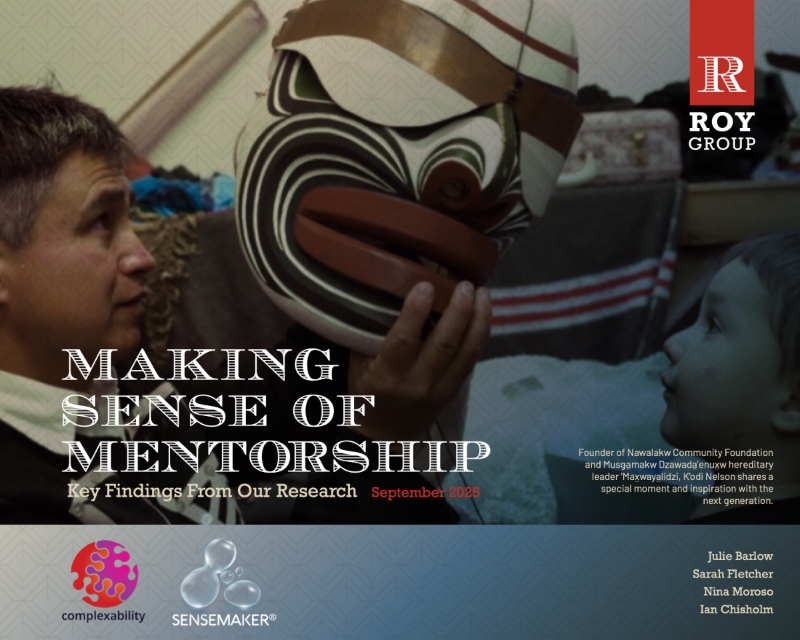
Roy Group's Research Paper: Making Sense of Mentorship - Sep 2025
,

Making Sense of Mentorship

I thought writing Quiet Champions would be about telling my own stories. But the real gold wasn’t in my experiences—it was in everyone else’s.


“The truth is in our stories.”

—David Snowden


***


I’m not a prolific reader—something people in my field rarely admit. My eyes wander, and I envy those who devour books. Which made writing Quiet Champions…tricky.

Luckily, before starting, I spoke with Daniel Coyle (author of The Talent Code and The Culture Code). He gave me two invaluable pieces of advice:

“You’re going to feel like you’re floundering.”
When the fog of confusion, insecurity, and procrastination rolled in, I kept going—thanks to that timely warning.

“Let me guess—you’re opening each chapter with a personal mentorship story.”
I denied it—strongly—while secretly looking down at my list of personal stories, chapter by chapter. Dan’s advice? Drop them. Use your experience for perspective but gather other people’s stories too. That stuck.

That’s when we turned to SenseMaker®, a survey tool from the Cynefin Co. that captures narrative fragments, multi-faceted perspectives, and makes them measurable. With Complexability Australia, we built a custom SenseMaker collector. Hundreds shared their mentorship stories, offered nuanced perspectives and disclosed personal insights.

Together, these voices revealed patterns no single story could uncover—insights we’d otherwise be guessing at. As David Snowden puts it, SenseMaker lets us “read the wind on the water”—a current strong enough to take us all somewhere better.

The truth really is in our stories. Especially when we listen together.

Discover More:

Want a deeper dive into the insights?

👉 Read the full mentorship research paper, Making Sense of Mentorship

Roy Group's Research Paper: Making Sense of Mentorship - Sep 2025

What we learned about mentorship

We collected hundreds of stories—from mentors at their best, and sometimes, at their most human. These stories stretched across industries, cultures, and generations. A thread ran through them all: mentorship isn’t a title or a program. It’s a relationship built on trust, presence, and action.

Three takeaways stood out:

  1. Mentorship is earned, not claimed.
  2. The most impactful mentors didn’t set out to be mentors. They showed up, listened, and created space for others to step into their own leadership.
  3. The relationship matters more than the structure.

Formal programs have their place, but the most powerful moments came from simple, human connections—a conversation over coffee, quiet encouragement, someone asking the right question at the right time.

It’s reciprocal.

Every story of a great mentor was also a story of a mentor who was learning, too. The best mentors are shaped by the relationship.

From these stories, five practices emerged:

  1. build trust and respect,
  2. listen more than you speak,
  3. challenge with support,
  4. align on values and purpose, and
  5. use simple, reliable tools.

This research confirms what we’ve long believed at Roy Group: mentorship is a practice, and it’s through the that practice that we earn the word “mentor.”

As we prepare to launch Quiet Champions in the weeks ahead, I’m grateful for these stories—and for the reminder that the next generation of leaders must be accompanied by mentors.


Share this newsletter, join us on Substack, and help us spread the word:


Find and Follow Quiet Champions here:


Let’s shape the future of mentorship together,


Ian Chisholm
Partner and Co-Founder


Find and follow Roy Group:

The Blog Takeover...sometimes a Chief of Staff must step in
,

The Blog Takeover…sometimes a Chief of Staff must step in

They say that when people spend enough time together, they start to resemble each other. While Chiz and I may share a similar flair for fashion, I can say with certainty that—even after 15 years of knowing each other and 5 years of near-daily contact—we remain very different people.

As Roy Group’s Chief of Staff, I tend to thrive away from the limelight. There’s little glory and a whole lot of action behind the scenes, and that’s exactly how I like it.

But every now and then, I’ll step into the spotlight for a good reason—which is why I’m taking over this edition of our newsletter.

***

Back in September 2022, Chiz asked me if I thought it would be possible for him to take a five-month sabbatical—and if so, what he’d need to do to make that happen. My optimistic answer was that of course it was possible. By saying it out loud, he’d already taken the first step.

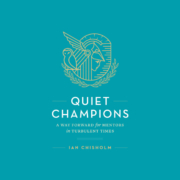
Twelve months later, Chiz returned from his sabbatical with terrific adventures under his belt and major progress made toward his forthcoming book, QUIET CHAMPIONS: A WAY FORWARD for MENTORS in TURBULENT TIMES.

I return to that conversation often, because I’ve had a front-row seat to the energy, effort, and perseverance Chiz has poured into this book over the past three years. It would be impressive enough on its own, but he’s done it while simultaneously building and sustaining a business, serving clients in meaningful ways, spending quality time with his family, and investing in his own well-being.

As Chief of Staff, part of my role is to operationalize strategy, steer the ship, and—when needed—deliver reality checks. Often that means poking holes in ideas to see if they’ll float. The idea of Ian Chisholm writing a book has never required that treatment. Every pulse check over the last three years has confirmed it: Quiet Champions is not only a good idea, it’s a necessary one. Not because it’s the boss’s pet project, or because it might boost Roy Group’s bottom line (though we certainly wouldn’t complain). This book matters because the world needs it—and Ian Chisholm is the one who had to write it.

***

In the weeks leading up to the book’s release, you’ll be hearing more from Chiz—and in different ways. Quiet Champions now has dedicated social media channels, and Chiz has already begun sharing “book-adjacent” writing on Substack. Soon we’ll unveil the official Quiet Champions landing page, where you’ll be able to find the book in print, e-book, and audiobook formats (yes, narrated by Chiz himself). We’ll also be releasing a research paper, Making Sense of Mentorship, highlighting the SenseMaker data we’ve collected—which many of you contributed your mentor stories to over the years.

Thank you for the tremendous interest and support you’ve shown Ian, and by extension Roy Group, throughout this book-making journey. Thank you for being our Quiet Champions.


Find and Follow Quiet Champions here:


Nina Moroso
Chief of Staff

Quiet Champions: a way forward for mentors in turbulent times
,

Sometimes the HOW is a WHO.

Twenty-five years ago, Anne-Marie and I were in the final few weeks leading up to the opening of the Columba 1400 Leadership Centre on the Isle of Skye. The contractor was keen to finish the Centre and have us sign off that it was complete. With zero understanding of the construction industry (particularly the Scottish construction industry), I was in a risky place. 

How could I approve a standard I had no understanding of?

Which is why we hired a Clerk of Works. 

A Clerk of Works is often a retired construction superintendent, who knows the industry, the game, and every shortcut, hoodwink and loophole there is. Walking beside me on his site visits, our Clerk of Works pointed out everything I needed to be aware of and subsequently make part of the conditions for completion.

That 25-year-old memory surfaced again this week during my conversation with Alex Van Tol.

***

Five years ago, I knew that I wanted to write a book. I had an appetite for a creative project. I also wanted to push myself. I wanted to extract from my head the large body of work I had been storing for 30 years and commit it to paper. 

I thought I was all in and ready to go. I thought all I had to do was write it. 

The truth is – I didn’t have a clue what this decision would mean.

But, I’m happy to say that I knew enough to know that I didn’t know enough. And that I would need to reach out, once again, and engage someone who did know the world of writing, books, editing and the publishing business. 

What I wasn’t expecting is one of the best coaching experiences I’ve ever had.


Alex Van Tol is an author, editor, and book coach with 30 years of experience in writing and publishing. Trained by the world’s foremost book coach, Jennie Nash, Alex helps writers plan and draft books that have more than just a shot at commercial success. She coaches writers of fiction, nonfiction, and memoir, with an emphasis on improving a writer’s craft and developing their market strategy. Alex has published 15 books with several different publishing houses and has assisted numerous writers in securing deals.

Alex offers high-touch, customized guidance with best-in-class advice on how to write and sell a complex, multilayered, personal work of art into a competitive marketplace. Her expertise is combined with some great coaching, which enabled me to process and sort out what was coming up for me as a writer. Alex reminded me often that “a book forms a permanent cornerstone of one’s reputation.” The book was going to be about the work – but it was also going to be about me. She helped me approach the engagement accordingly.

Every two weeks, Alex provided me with her deep feedback and guidance via notes on the page, audio recordings and/or editorial letters. Each round of feedback included a coaching call to talk through questions and dig into tricky fixes.

Five years later, I can report that the publishing industry is still confusing and changeable, full of arcane rules, gatekeepers, and contradictory advice. Conditions change on a dime and there is no straight line to success. The marketplace can be discouraging to navigate, especially for someone who doesn’t know how publishing works.

Writing is a trade, and as such there’s a degree of mastery involved. Putting a book together by myself would have been like building a house using YouTube DIY videos plus tips from the guys at the hardware store: not impossible, but slow, experimental, and possibly bad. Instead, working with a book coach was like hiring a Clerk of Works to stand right beside me (again), guiding my creative project as I drew the plans and measured the wood. I know my book is written well because I worked with a pro – one who helped to steward me and my book towards my best publishing option.

If you are thinking about writing a book, I strongly suggest having a conversation with Alex. Alex will help you find the right path for you.


Ian Chisholm
Partner and Co-Founder

,

Right Person, Right Time.

One of the themes that emerged loud and clear in our Sensemaker research project on mentorship is the importance of timing. The right mentors seem to come out of the woodwork at exactly the right time. When we need them, they show up. 

This was certainly the case for me this time last year, when I bumped into an old acquaintance named Jill Payne.

Jill and I met by phone almost a decade ago. She was starting her own coaching practice in New York City and a friend suggested that Roy Group might be an interesting prototype for her to consider. It was exciting to hear about Jill’s experience as an elite athlete on Canada’s National Rugby Team and her first few years in the world of work as a fitness trainer. 

I could tell she was going to bring a unique perspective to her work with clients needing her help. I just never guessed that one of those clients would be me.   

***

Jill and I crossed paths again early in 2024 – at the book launch of a mutual friend. It was clear that a lot had happened in the past decade and there was a lot we had to catch up on. Jill was now a mom and had relocated back to Vancouver Island from NYC. Jill had published her own book, Be A Dime and very successfully navigated her way from the world of fitness training to working with a wide range of organizational clients in the much more complex arena of addressing their whole lives as leaders. I could again tell that Jill had a unique contribution to bring to this work. We decided to meet for lunch. 

Over that lunch, I got my world rocked. I shared with Jill that I had made a bit of a mistake in 2023 – taking a 5-month sabbatical to write my book, but not actually finishing the writing of it. I had let my writing coach, my team and myself down in not keeping my promise. Now I was back in the thick of my work at Roy Group, and flailing to find hours here and there to drag my pen across the finish line and begin the work of finding a publisher. It all felt like I had tucked myself behind the 8-ball, and I expressed to Jill that I was exhausted.

Little did I know, I had just used a word that Jill has some clear convictions about. 

“Are you exhausted, Chiz – or are you just not managing your energy like a pro?”

Jill went on to explain that one thing she always noticed – as an athlete, as a single mom, as a personal trainer to some very high-level clients in New York, and now as a coach – was that the people who were able to commit to doing important things in life and follow through on them, had engineered a way of replenishing and protecting their energy reserves. This idea captured Jill’s imagination, and she began creating her Be a Dime approach to help others do the same. She thought working together might be something that would add some exciting layers to my life. And I agreed.

And it has.

Jill doesn’t provide prescriptions – there is no workout regime, no strict diet, and no mandatory hours of meditation. She offered a wonderful online set of modules and showed up herself for a conversation with me every few weeks. She helped me grasp that before I get ready to plant the seeds of my intentions in life, I would be wise to pay attention to the conditions that I was placing those seeds into. Was I tending to the soil of my own physicality, my focus and my internal dialogue? Was I taking a reasonable amount of time to tend to myself before tending to my work? The short answer is that I was not. And that was the opportunity. 

The biggest single change I have made in the last year was not dramatic. I choose not to touch my professional work until 9AM. For me, this was a huge departure from the norm. For decades, I prided myself on waking up early and getting as many emails in play as I could before the day started for everyone else. I thought I was really on to something. I still like getting up early – but now the combination of rising early and not touching work until 9AM gives me a solid block of time – for my life. I make Anne-Marie a coffee and take some time to enjoy it together. A natural appetite to move and stretch and sweat has landed me at the gym 240 times since 1 April 2024. (That is 20 times per month – a vast improvement over any streak I’ve ever been on before). I am paying more attention to what I feel like eating and what foods leave me feeling good after I eat them. A good night’s sleep is a big priority, whether I am at home or on the road. 

I don’t feel exhausted by hard things anymore. I like the idea of being the sort of person who is capable of doing hard things when I need to. And also the sort of person who rests more, laughs more and enjoys life more. 

I strongly recommend any opportunity of working with Jill – 1:1 or with your team. I’d be happy to make an introduction or have you reach out to Jill directly to find out more.  She is the sort of person worth meeting. 


Ian Chisholm
Partner and Co-Founder

,

Fogo Island – community rooted in place

Photo by Iain Duncan


I have a special assignment coming up on Tuesday.

As part of the Rising Economy Conference hosted by the South Island Prosperity Partnership, we have invited Zita Cobb to headline the gathering. You have probably heard about Zita over the last decade as the creator of the legendary Fogo Island Inn and founder of the Shorefast Foundation.  Zita is a no-nonsense force in the world when it comes to economic development, social enterprise and community.  She does not suffer fools and the way she says things sticks with you for a very long time.  If you ever have the chance to meet Zita – you will never forget it.

It also puts a big smile on my face to tell you that she is a friend and mentor of mine – and I will have the experience of interviewing Zita in a house full of my own neighbours.

***

In 2023, I spent a month on Fogo Island as part of my writing sabbatical. I had been to Fogo Island twice with Power To Give field trips and knew that it was a place that I wanted to spend some extended time.  In exchange for some embedded work with Shorefast teams over the month that I was there, I was put up in Sadie’s cottage, a stone’s throw from the Inn. I would write every morning and walk down the road to work with groups every afternoon.

As luck would have it, Zita was on Fogo that April – and we had the chance to spend some time together. This time was filled with the kind of conversations that draw your complete attention away from the sunset happening behind you.  These were the kinds of conversations that helped me tap into things I had never thought about before – and reconnect to important themes that I had lost in the shuffle. It was the kind of conversation that changed the tenor of the book I was writing – and the course of the life I have been living since.

Zita believes in the power of place.  That every community needs to have a place that it can invite the world to experience what it means to be from that place.  She redefines what a ‘resource’ is, and what an ‘asset’ is – and the relationship between the two.  She believes in the unifying power of endeavor and she believes in the dignity that comes with meaningful livelihood. And she believes that money will do anything that we tell it to – to create the kind of communities that an increasingly turbulent world will need.

I left Fogo Island seeing my work through the realm of community.  The promises of mentorship and indeed leadership, in their truest form, come from this realm of community. It’s where they’ve always lived. Which makes the fact that community is a disappearing way all the more problematic. Mentorship requires the collisions and connections of community. True leadership moves at the speed of community.

For generations, communities have had ways of sustaining themselves…but these ways are deteriorating at a rate greater than they’re being strengthened. Our sense of place is being lost faster than the technological promise to actually connect us is being realized. The dawn of so-called social media made all kinds of promises. People who share a passion will be able to find each other and make things happen! That ended up being a bit of a blessing and a curse. What it actually provided was a way for each of us to find the 50% of the people across the planet who agree with us—not the people who we’re actually in community with. The ones we have to figure out a way forward with.

What social media can’t do is be a place. It can’t drop off a tray of lasagne on the step of a neighbour who’s just lost a relative. It can’t rebuild a barn after the tornado. It can’t swing by and take your kids to soccer practice to save you a trip. A commitment to being in community provides the chance for us to gather and notice each other in situ. To notice if someone has begun to struggle, or recover. To notice if someone is thriving. To notice if someone else is starting to lead, or might be available to us as a resource, maybe even as a mentor or a friend. It allows us to experience and share in the food we eat here, the songs we sing here, and the way we say things here. It’s a place where we take accountability for what we say because we’re going to see each other in the grocery store.

It is in community gathering that we understand the place where we are from. The place we are of. The place where we will be buried or have our ashes scattered.

Some communities still have a way that we can emulate. The sabbatical gave me the chance to spend time in a collection of communities with their backs against the wall. Small prairie towns and island villages up against a threat and hanging by a thread, fighting to protect their livelihoods, values and distinct ways of life. Remote indigenous communities indefatigably working through centuries of adversity and trauma – relying on their language, songs, dances and each other to keep on a healing path.

In these communities, the thought that we don’t need each other is incomprehensible.

It is most notably when a community is vulnerable to being lost that it suddenly realizes its own value. This “value” is difficult to monetize, which is why I sense we ignore it until it is almost gone before realizing with a start that it’s worth fighting for. Most of us fail to see community as an equal pillar to education, government and enterprise.

Because it isn’t equal.

It’s worth more.

For all of you who will be able to join us next week at Rising Economy – I can’t wait to see you and introduce you to my friend, Zita.  For everyone else, we will do our best to get some footage of the event. Until then, just keep finding ways to make your community just a little bit stronger today than it was yesterday.


Ian Chisholm
Partner and Co-Founder

,

The Leadership That Might Be Ours

The New Year has certainly shone its spotlight on positions of leadership – the concept is centre stage and drawing our attention. Leaders stepping down. Leaders stepping into the vacuum left behind. Promises of a good future if we follow this leader – but not that one. Leaders saying whatever shocking phrase they need to – to keep our attention on them.

I am normally a careful optimist. In the last month, however, my sense is that there are death stars being built in every corner of the sky. Ungovernable technology, agendas and greed. Climate change, war and a widening gap between those in poverty and opulent wealth (alongside a widening gap of how much people even care). It’s clear that as a species, we’re going to have to raise our game to keep pace with (and change) where this new order of things is taking us. We’re going to need quantum leaps in our consciousness – as individuals, as teams, as communities and as societies. We are going to have to be very clear about what actually makes our lives on this planet better.

Because we are relying on our next generation of leaders
to face some wickedly complex dynamics.

***

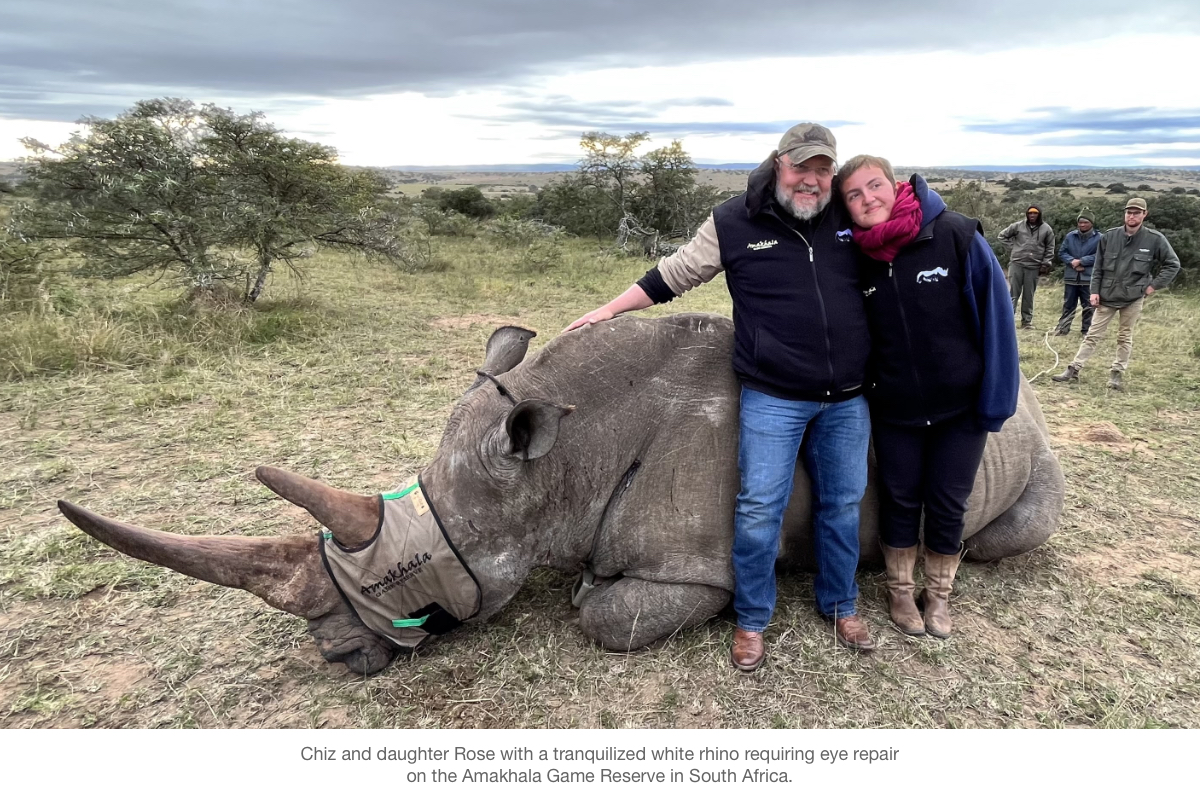
A few years ago, my daughter Rose and I spent a month in South Africa together as part of my sabbatical to work on my book. South Africa is an incredible country with a rich and turbulent history. Rose and I shared an incredible opportunity to step out of our normal lives and get some perspective. When I wrote, Rose would read. And over dinner together we would talk about where our work had taken us.

One of the books Rose dove into was entitled ‘Black Consciousness – A Love Story written by Hlumelo Biko – the son of Mamphela Ramphele and Steve Biko, founders of the Black Consciousness Movement. One evening she explained to me a risk that the author had addressed – when our attention is drawn over and over to those who are leaders (the way in South Africa conversations will often lead to the extraordinary life of Nelson Mandela), we begin to stop recognizing ourselves (and those around us) as leaders.

What happens if…we bring our attention back to the leadership that might be ours?

What if we notice…our own appetite to step into the turbulence rather than just watch it?

How might we walk…alongside our next generation of leaders and help them navigate a genuinely better way forward? 

  This question is the focus of my book project, ‘Athena’s Way’ – written for mentors who want to accompany our next generation of leaders – coming out this fall from Page Two Publishing.


For any leader to stay grounded, make clear decisions and take calculated risks in unpredictable conditions – they need to be connected to others. Their capacity to lead well relies upon a constellation of mentors around them – a council of the willing, wise and deeply invested. We need others to help us recognize patterns, contemplate layers of ethics and consequence, and run the kinds of experiments that just might show us a way forward through complex times. We need to help each other engage wholeheartedly and find the most meaningful way forward.

Every entrepreneur, scientist, activist, public servant, mother, uncle, artist and CEO will need to be surrounded by a council like this. So that each of us can go and create the triumphs – and stay clear of the disasters – that a few years ago, we never dreamed would be on our doorsteps. We need to be the kinds of leaders in community who create space for honest conversations about fear, failure, frustration – and finding the way forward.

We cannot be the kinds of leaders that take up all of this space ourselves – like most of those leaders who have been drawing our collective attention, the last few weeks.


Ian Chisholm
Partner and Co-Founder

,

Chiz’s Writing Journey: Decisions, Doubts, and the Heartbeat of Mentorship


Three years ago, I declared to the world that I was writing a book.

So, I started writing. But back then I had no idea how multifaceted a book project is. How much time it demands. How much emotion it unearths. How many decisions have to be made.

Then work got in the way. Pandemic recovery got in the way. Life got in the way. The work started to feel like a shovel that’s collected too much snow, and, sweaty and swearing, I threw it down.


A year ago, I started over.

I went on sabbatical, with the intention to actually write the thing. I had five months of open time. I was going to finish this book.

It was a great experience. For the first 8 weeks it felt like I was working on the book. Then the book started working on me! Big experiences on Fogo Island, Newfoundland with the Shorefast Foundation and in Alert Bay, BC with the Nawalakw Healing Society stoked the fire and deepened my convictions about mentorship and community. These themes continued in South Africa accompanied by my daughter Rose. A combination of taking part in Trip With a Purpose (a creation of old friends, Mike and Lauren Slattery) and visiting Columba Leadership in Johannesburg made an impression on both of us that will last a lifetime. One last month in Scotland gave me the chance for important conversations with friends and mentors there and the opportunity to reconnect with Columba 1400 on the Isle of Skye.

And through it all, I wrote to make sense of what was happening.

In September, I came back to Roy Group—ready for our 20th year in business.


I am still writing.

Writing a book is ridiculously hard. I am so grateful for a conversation with Dan Coyle (author of The Talent Code and The Culture Code) who warned me that I would feel as if I was lost at sea. If he hadn’t thrown me that little lifesaver in advance, I think I would have quit by now.  It’s a massive project, not totally unlike building a start-up, with an equal number of complexities.

Worse, my book is about this ephemeral thing called mentorship. How do I capture such a nuanced role on the page? How do I write a book teaching people how to be a mentor when one of my core convictions is that you can’t call yourself one? 

Why, so often when I sit down to write, am I gripped by doubt?

It’s work worth doing, but man, is it exacting. I’ve had to examine, stress-test and push back on every one of my beliefs around mentorship to see which ones hold fast in my heart. I’ve jettisoned things that felt like convictions, but that I now realize are too narrow to matter in the bigger conversation.

To top it all off, I’m being utterly schooled as I go: rewriting passages that are vague or cryptic or just plain boring; having my brain melt into pieces as I try to decide for the seventh time whether I want to wait in the two-year lineup over at the traditional publishing pavilion, or just get the thing into your hands before the world tilts again and I have to rewrite it for a different landscape.


What’s my point?

Despite what feels like slow progress, the book will be coming out sometime in the next year—which is awesome, because this dovetails with Roy Group’s 20th anniversary in September.

Incidentally, What’s your point? is one of the questions that needed an answer in the blueprint I built to guide the entire book’s writing process. I’ll share a few of the other things I needed to ask myself, so you know where I’m headed with it. Things like:

Who the book is for.
(That’s you.)

Where the book will sit in the bookstore.
Easy: personal development. This goes much deeper than leadership.

What similar books my audience might be reading.
I picked Meditations by Marcus Aurelius and How to be an Adult in Relationships by Dr. David Richo, plus a few others.

My working title. Mentor’s Way.
It’s a nod to The Artist’s Way, because I hope this book is just as effective at creating meaningful change in people’s lives.

The logline.
In Hollywood, a logline is a quick summary you can say in one outbreath. Here goes:
Mentor’s Way is a collection of conscious mindsets, skill sets and motivations a leader needs to take forward (and a few things they need to leave behind) if they would like to be remembered as someone’s mentor.

If I take just one more teensy little breath,
I could also add that it’s a manifesto for the mentors of our next generation of leaders.

What’s the structural prototype of the book?
Conceptual. Think The War of Art by Steve Pressfield.

I could tell you about each of the other 14 parts of the blueprint for this book.
They’ve been enormously helpful in guiding me as I develop the content. But they’re not the core of the thing.


The beating, hopeful heart of what mentorship really means.

What it really looks like, what it does to you deep down inside, and how it’s a powerful enough lever to shift the whole world.

That’s what the book is for.

So glad you’re in the loop with me on this one.


Want to read an excerpt?


roy-group-poster-we-are-not-built-for-easy
,

Ten Takeaways From 2022

Well, we’re still standing! Wasn’t easy.
(Pretty sure easy is long gone in that rearview mirror.)

A few of us at Roy Group dug deep as the year drew to a close, asking ourselves what the most impactful learnings were over the last 12 months. Here’s what Yo, Duncs, Nina and Chiz had to say.

  1. “Trust is grease and trust is glue.” This little gem was spoken by former Governor General David Johnston in an interview with Chiz. It’s coming up everywhere in our client work. Coming out of such turbulent times, we see people needing to work fast and be aligned. This only happens with trust. We’ve spent much of this year working on this piece ourselves at Roy Group.
  2. People are tender. These past three years have gone down so uniquely inside each human. When a person finishes a marathon and the adrenaline dips, it hits. Seems to us that this is where people are at nowadays: deeply feeling the impact of ploughing through the last few years. Proud of themselves, for sure—and needing some recovery.
  3. “Money will do anything we ask it to.” This comes from our friend Zita Cobb. And it’s a humdinger. Look at the world we’ve shaped all around us. The degree to which we overfund things (like the World Cup in Qatar) and underfund things (education…innovation…our safety net) is staggering. As individuals, teams and countries, what are we going to ask our money to do? Because it will do anything we ask it to.
  4. The world needs a new kind of space. Where people can hear each other. Re-entering the world of in-person gathering has shocked us with distractions that now feel deafening: HVAC, noise pollution, traffic. Roy Group is on the hunt for well-sounded rooms in 2023—and the conversations that can happen within them.
  5. Leadership is a team sport. So is mentorship. Most people have such a strong mental model that these things come in the form of extraordinary individuals. And it is just not the full picture. It happens as a team.
  6. If some of your work doesn’t make you uncomfortable, you’re probably not growing. A great lesson from D’Ari Lisle at Darkspark, when challenging a room full of philanthropists to reach out to orgs doing work they don’t yet fully understand. Challenge is uncomfortable. Growth is uncomfortable. Truth and reconciliation can be uncomfortable. If you’re pushing the limits of what is, leaning into the story of what could be, you’ve signed up for regular bouts of uncomfortable. Good.
  7. When the stakes are high, people come ready for the work. Feeling invested is the mother of all ambition. When Roy Group works with communities whose language or way of life are at stake, they show up ready to do the work. It shows. The opposite holds too: resistance and foot-dragging are signs that a lack of emotional engagement is messing with focus.
  8. Let go to move forward. You must be willing to release some of the old ways to let the new ways in. The last few years have allowed people to see what’s possible when it comes to how and where we work, communicate, socialize and team build. But we can’t bring back everything we used to do plus add in all the new ways and expect it to work. That’s like topping a burger with a burrito.
  9. People crave purpose. We’re sensing less collective tolerance for doing work that serves scattered objectives or contradictory focus. Get clear—and watch reach and alignment grow.
  10. We are the work. Roy Group engaged a business consultant this year to help us take a hard look at our positioning, refining it to reflect our why and learning how we can improve and streamline operations to serve our clients even better. The last few years have been a bull ride and many of us have been exhausting ourselves just to hold on. Holding on isn’t good enough anymore. As we let go to move forward (see #8 above) we have to muster our stamina for the intentional change we hope to manifest in the year ahead.


And we wouldn’t be Roy Group if we didn’t invite you
into some meaningful reflection yourself…

Cofounder Anne-Marie Daniel offers a few questions to prompt some reflective journaling, or to foster some deep-reaching conversations around the holiday table:
someone writing in a journal

  • What are your best learnings for the year?
  • What are you most proud of?
  • Whose life path and leadership are you glad to have supported?
  • How did your routine support you this past year? How did it not?
  • What is one easy adjustment to support the atmosphere inside you in 2023?
  • What is one addition to your bucket list?


Photo by Jessica Delp on Unsplash

image-nimmo-bay-mountain-sky-reflection
,

Your Top 7 Questions Answered About Team Retreats

Your life is a spinning circus. The bank website wouldn’t let you log in this morning, you lost an hour on the phone troubleshooting the new CRM, and a colleague from way back emailed to say they just saw your teenager on YouTube streaming political commentary under his own name (and therefore yours).

Oh, and your director group just informed you that the culture is flagging now that everybody’s working from home three days a week. And your star performer—the one you can always count on—gave their notice last week.

It’s like a Choose Your Own Adventure, except you never finish, you never die…and you’ve brought your whole team along for the ride.

Might as well start right there, with how to knit your people tighter. Because we’re all pretty clear by now: your culture is determining what you’re capable of.

* * *

The way teams function is undergoing an overhaul.

Two years of social distancing has changed the way we work. This shift has delivered some good things: less commuting; fewer emissions; hybrid workflows that often improve life balance.

It has also left some teams floundering. Leaders are wondering, How do we foster meaningful relationships and enable productive teamwork in this new territory? How do we build a healthy work culture in 2022?

It feels like we’ve gone from COVID pivots to the brink of burnout, and now we’ve landed in this grey area where we haven’t quite recovered from what came before…and we aren’t quite sure what lies ahead. Even with restrictions lifting and people returning to the office, we know we are still missing real connections.

The custom retreats we’ve been receiving inquiries about include clients asking about time in nature together, having long meals together, being somewhere special together, and celebrating the fact that they get to do their unique brand of work together.


Here’s what people are asking us:


QUESTION #1

Why does my team need a retreat?


Short answer: everything in org functioning comes down to relationships.

Every door that opens, every goal you achieve, every customer you acquire, assist, retain or fumble…your organization’s success comes down to the quality of your relationships. How far will people go for you? How hard will you play for them? How hard will they play for you?

Relatedness (whether people work well together) is a key element of high-performing teams. It’s the one that challenges leaders most—but it’s the biggest lever for culture.

The casual connections of the workplace we once knew are no more. Teams are dispersed. People are living inside a whole new layer of stress. New teams struggle to know each other on a personal level. People feel disconnected from a sense of purpose and belonging. Trust is at an all-time low. And change—especially the relentless, slap-you-in-the-face kind that just keeps coming—is hard.

Teams need time to reengage with one another as humans, not just as people connected by a common workplace. They need to build trust and psychological safety. They need to see each other as people first, colleagues second. Only then can people shift their focus to things like annual targets, strategic goals or their leadership practices.

Plus, taking your team away makes people feel valued. And research shows that recognition is often a more powerful motivator than money.

What’s extra great is that with a Roy Group team retreat, you build relationship skills at the same time that you’re building the relationships themselves.

QUESTION #2

 What does a typical day of a team retreat look like?


Whatever you want it to look like. Generally, a well-rounded day together involves some “me” time on an individual level, time together and alone in nature, three excellent meals, a group activity where we go off somewhere to feast or explore, and a structured session where you drill down on something that’s important to your roadmap forward.

Maybe you’ll want to build in a complete program like Focus on Self, which is well suited to the greater sense of openness that a retreat brings. Or you might dive into how to strengthen alignment with The Collaborative Team. Or learn tools for putting ego aside and seeing others’ perspectives with Engaging Difficult Conversations. Endless options.


QUESTION #3

How will my team or organization be different afterward?


Imagine having an opportunity to talk together, authentically and unscripted, about your culture. To see each other as people outside of a work setting. Outside of roles, pressures and deadlines.

In a retreat setting, there’s so much more space for intuition, nonverbal communication, play and shared experiences. It’s like a jazz jam compared to a solo.

It’s astonishing how quickly people can ideate creative solutions to problems that seemed intractable under the fluorescent lights of the office. Astonishing how easy it is to find alignment when everybody really gets what you’re working toward together.

Before a team retreat, your people could be grappling as individuals without tools and skills, or the knowledge of how to use them effectively. You lack a common language, and a set of common experiences.

After a team retreat, your vision is suddenly clearer, your objectives seem somehow reachable, and your people feel refreshed and valued. They’ve honed their focus, dug deeper to understand how their roles and responsibilities contribute to excellent performance, and have a better understanding of who else on their team they can turn to for support. You can see the makings of a high-performing team.

They’ve learned to play together—for each other.


QUESTION #4

What are some specific things a retreat can dig into?


  • Articulating what you’re truly struggling with.
  • Strategy, team composition, new workflows.
  • Deciding which business lines to let go of.
  • Coming to grips with change, and building tools to navigate it—two different things.
  • Refining or reassessing your organization’s purpose.
  • Taking steps together toward the things the team feels are truly important.
  • Taking stock and choosing a heading.

This last bit is especially important. It’s easy for people to get completely fired up during a retreat…and then lose track of the pieces after returning to the office. We can help you close out the process by developing a roadmap or custom-shaping you a Roy Group pathway, where we build in an accountability structure to make sure you stay the course.


QUESTION #5

How can we afford to pay for a retreat?


Organizational advisor David Baker has a good answer for this. (His emails are great. You should get on his list.)

“Set aside that rent money for culture building,” he writes. “If you go remote-first, that doesn’t mean you automatically eliminate the big “Rent” line item from your Income Statement. A good chunk of that should most likely be reserved for in-person teambuilding, whether that’s a big annual retreat or more regular in-person gatherings.”

Our practice leads can work with your organization to find the sweet spot between your fiscal realities and…well, limitless possibilities.


QUESTION #6

 What makes now the right time to consider a team retreat?


The last couple years have been hard as hell on most of us. But even hard things demand closure—a grieving of sorts.

We need to acknowledge that we have been through something—that we’ve suffered and prevailed, and that we are each warriors in our own right. We need to engage Henderson’s Disciplines by pausing, reflecting and inquiring, before we can embrace the next chapter of action.

Now is the time to come together and reflect on these last two years. What went well? What was tricky? What do we need to do differently?


QUESTION #7

 Where would we do a retreat?


That depends on your budget and the activities you want to engage in. One of our Alberta clients, for example, recently came for a retreat on Roy Group home turf, so we built in coastal exploration in voyageur canoes and whale-watching. We had small groups working in the forest, on the docks, and on the grass at the ocean’s edge. Retreaters shared exceptional meals together, learned from a local First Nation, and bedded down in the oceanfront comfort of the Oak Bay Beach Hotel.

We have hosted our own team retreats at Bilston Creek Farm

…and we share a longstanding partnership with Nimmo Bay Wilderness Resort, where our exquisite experiences will have your team talking in the staff room for decades to come.


* * *

If you’ve been thinking about a team retreat to help bring your people together, reset, and choose a fresh heading filled with purpose, drop us a note. We are booking into the fall—and we’d love to work (and play, and feast, and plan) with you.


©2026 Roy Group | Privacy Policy